

Recipe costing with real purchase prices
See what a recipe costs and what you should charge while you are still building it. When purchase prices change, the cost changes with them.
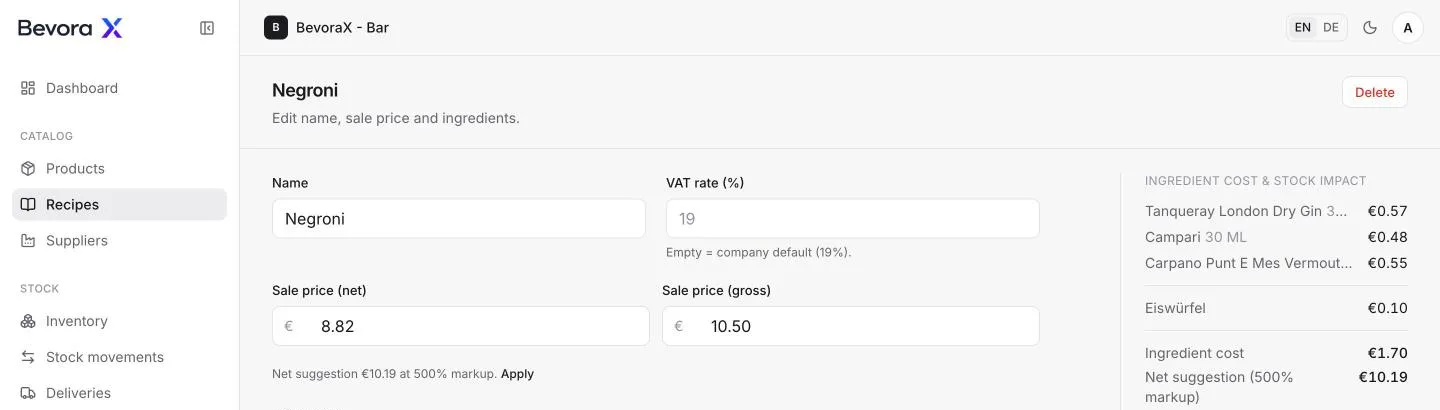
The problem
Recipes get costed once, usually in a spreadsheet, then the supplier raises prices. The menu stays the same and the margin quietly shrinks. Nobody knows exactly how much stock a sale really uses.
How BevoraX solves it
Live cost in the editor
As you enter ingredients and quantities, BevoraX calculates the cost from your purchase prices. If a price is missing, you see it immediately.
Suggested price from your markup
Set your target markup once. BevoraX suggests a selling price per recipe that you accept or adjust.
Net, gross and VAT
Enter selling prices net or gross, with a VAT rate per recipe. Revenue and margin are always reported net.
Sales deduct ingredients
Every sale breaks the recipe down and deducts each ingredient at its FIFO cost, including sub-recipes such as syrups or bases.
How it works
- 1
Add ingredients
Products with purchase price and content, entered once.
- 2
Build the recipe
Enter ingredients in ml, g or units. Cost and suggested price appear live.
- 3
Sell
Record sales or scan your POS report. The ingredients are deducted.
Worked example
Costing an Aperol Spritz
- Aperol, 60 ml (0.7 l bottle at €14.00)
- €1.20
- Prosecco, 90 ml (0.75 l bottle at €4.50)
- €0.54
- Soda, orange and ice
- €0.16
- Cost of goods
- €1.90
- Target markup 300% (cost × 4)
- €7.60 net
- Gross selling price with 19% VAT
- €9.04
Gross profit per glass: €7.60 minus €1.90 = €5.70. Cost of goods is 25% of the net price.
Frequently asked questions
How do I calculate the cost of a recipe?
Recipe cost is the sum of all ingredients, each quantity times its purchase price per unit. BevoraX converts the price per bottle or pack into a price per ml, g or unit and multiplies it by the quantity in the recipe.
What is the difference between markup and margin?
Markup is based on cost, margin on the selling price. A 300% markup on €1.90 gives €7.60 net. Gross profit is then €5.70, which is 75% of the net price.
Can I use sub-recipes such as syrups or sauces?
Yes. A recipe can use another recipe as an ingredient. When it sells, the sub-recipe's ingredients are deducted too.
Which purchase prices does the costing use?
The average value of your current stock, or the purchase price from the product data when there is no stock. Booked sales use the FIFO cost of the stock actually used.
Related features
Scan delivery notes instead of typing them
Upload a photo or PDF, review, confirm. AI reads the supplier, lines, quantities and prices and turns them into a goods receipt. Your POS end-of-day report works the same way.
Learn more →Catch shrinkage before it gets expensive
BevoraX compares what sales and recipes say should have been used with what the stock count shows. The difference gets a number, a product and a location.
Learn more →
Try it with your own data.
Free during the beta until 31 Dec 2026, no credit card. Or let us walk you through it in a short demo.